 Member rights and interests


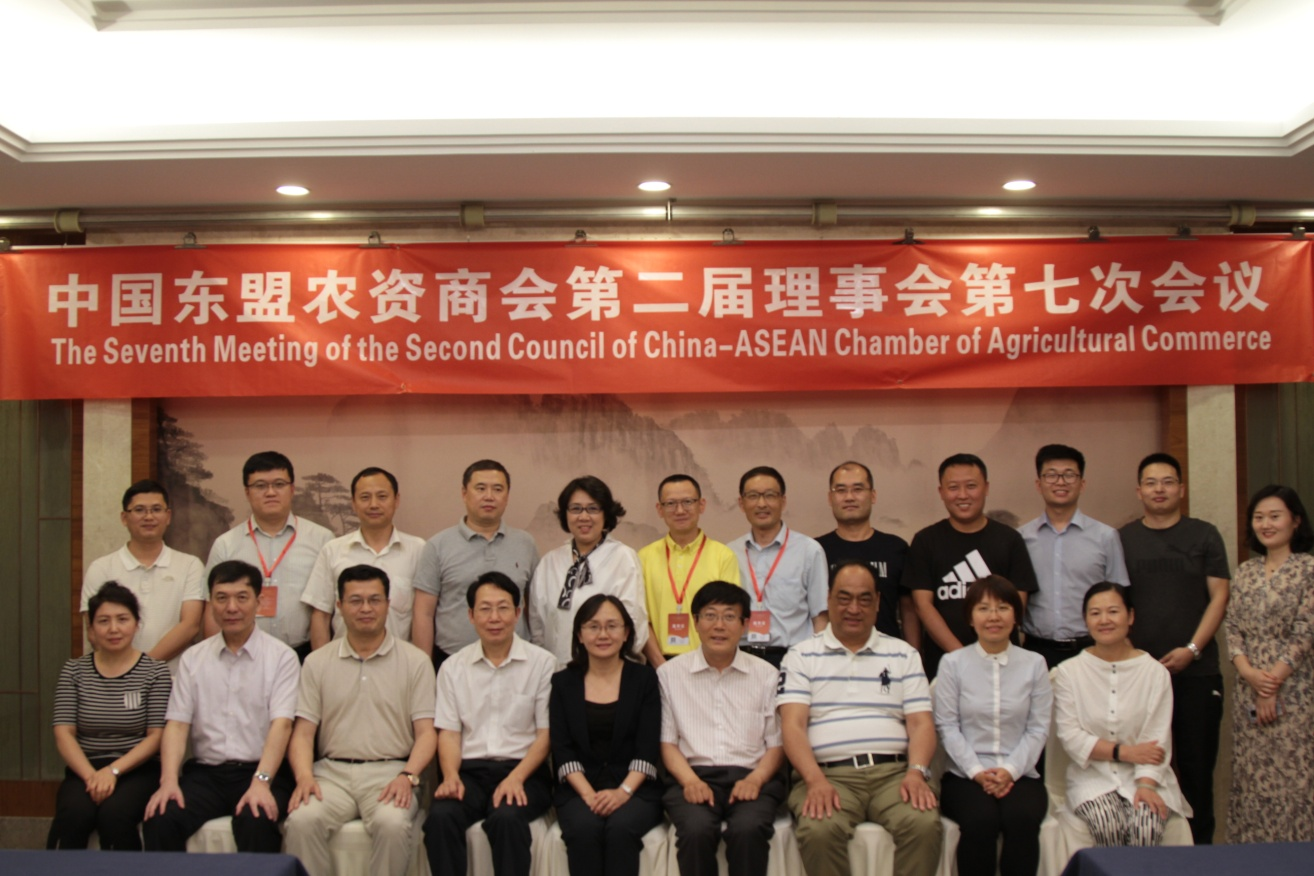
On June 12, the 7th meeting of the 2nd Council of China-ASEAN Chamber of Agricultural Commerce (CACAC) was held in Hangzhou, Zhejiang Province. The meeting summarized CACAC’s work since the 6th Meeting of the 2nd Council in July 2018, planned out the key tasks for the next stage, established the Expert Committee of CACAC, and deliberated and voted on relevant issues. Ms. Long Wen, Inspector of Bureau for Agricultural Means of Production & Cotton and Jute (BAMPCJ) of All China Federation of Supply and Marketing Cooperatives (ACFSMC) and President of CACAC, summarized the meeting. Ms. Fan Huiqun, Division chief of BAMPJC of ACFSMC and Vice-president and secretary-general of CACAC, delivered the work report and financial report of CACAC.
In her conclusion remark, Long Wen pointed out that in the past year, CACAC has actively participated in the construction of the Belt and Road, closely interacted with the embassies and related departments of ASEAN countries and others, strengthened market research and support of policies and project funds, and organized a series of pragmatic activities, making new progress in work. In the next step, CACAC will focus on the following three areas: first, to strengthen publicity and research so as to expand influence and cohesiveness; second, to promote “bringing in and going out” and expand cooperation in various fields; third, to further accelerate service innovation and upgrading and explore new ways for development.
Fan Huiqun reported on the work from four aspects: first, enhance internal and external work contact, expand communication and cooperation channels, and assist relevant institutions to carry out multiple economic and trade exchanges and business matching activities; second, reflect the voice of the members through various channels and promote the complete abolition of Chinese fertilizer export tariffs in 2019. Meanwhile, strive to stabilize the scale of commercial reserve of chemical fertilizers in the off-season and seek and obtain financial support from international projects. The third is to carry out the 2018 China-ASEAN Agricultural Industry Summit Forum and other brand activities, launch activities such as “Double Excellence into ASEAN”, expand publicity, exchanges and cooperation; Fourth, prepare to establish the Expert Committee of CACAC, amplify systems and strengthen services. In 2019, CACAC will seize the opportunity of the rising agricultural, economic and trade cooperation, carefully analyze the situation to strengthen capacity to respond, actively build platforms to carry out activities, further integrate resources to broaden the cooperation path, and better serve the government, industry and members.
The meeting reviewed and approved CACAC’s membership exemption list, new added membership list, the adjustment of president and some vice presidents, appointment of the deputy secretary-general and department heads, etc., and agreed to form the Expert Committee of CACAC. It also passed the role and management measures of the Expert Committee of CACAC and voted for Long Wen as the president of CACAC.
During the meeting, the first plenary meeting of the Expert Committee of CACAC was held, which reviewed and passed the membership list of the Expert Committee, the secretary-general candidate, and the work plan. As the advisory body and think tank of CACAC, the expert committee will better provide professional and scientific support for international agricultural cooperation, development of CACAC and its members through policies, market research, consulting services, decision-making advice, project review, talent and technical training and exchanges and other activities.
The fourth plenary meeting of the International Trade Committee of CACAC and the second plenary meeting of the International Water Soluble Fertilizer Branch of CACAC were also held during the meeting, which studied the market situation and development direction of China's agricultural means of production industry and related industries under the new global production and trade pattern, promoting matching of production, sales and trade resources.
At the meeting, representatives carefully reviewed and fully affirmed the work of CACAC last year, made comments and suggestions on its future work, and conducted full exchanges and discussions.
Tan Ming, member of the Party Group and deputy director of the Council of of the Supply and Marketing Cooperative of Guangxi Zhuang Autonomous Region, said that as the southward passage and strategy support of the Maritime Silk Road, Guangxi has the advantages of the port and China-ASEAN Expo, and can provide greater convenience for enterprises going out, which is promising for agricultural means of production industry.
Zhang Xuhong, vice president of China National Agricultural Means of Production Group Corporation, pointed out that in 2019, Chinese agricultural means of production enterprises will face greater difficulties and demand for fertilizers will decline. Chinese agricultural means of production circulation enterprises should learn from the experience of agricultural associations in Japan and Korea, do well the agricultural services, and pay attention to the agricultural “Go out” strategy. It is hoped that CACAC will further promote the process of internationalization in future development process.
Chen Zhihao, deputy general manager of ZJAMO Group Co., Ltd. introduced their practice of promoting the transformation and upgrading of enterprises, and thinking on future development of agriculture. He said that the Sino-US trade war has increased market uncertainty. In the future, the transformation and upgrading of the agricultural means of production industry will focus on resources, technology and services. It is necessary to enhance the technological content to promote service appreciation and break through the traditional formats and models. It is hoped that CACAC will better organize and promote enterprises to integrate technology and funds and participate in the construction of the Belt and Road.
Zhang Dinglin, chairman of Yuanji (Shanghai) International Logistics Co., Ltd., said that domestic enterprises are facing overcapacity problems, while Southeast Asian countries have demand for agricultural means of production. I hope CACAC will strengthen the construction of branches and partnerships in the 10+3 region so as to jointly pool resources and build supply and demand matching platform to help domestic enterprises "go out".
Huang Shaobin, vice chairman of China-ASEAN Chamber of Agricultural Commerce in Hong Kong and vice chairman of Guangxi Jianjin Investment Co., Ltd., suggested that CACAC and the supply and marketing cooperative system should be more integrated into the national strategy. There should be more interaction and integration between agricultural means of production and agricultural products. It is suggested that CACAC together with leading enterprises increase research on subjects and issues.
Zhang Qin, deputy editor-in-chief of China Agri-Production News, said that currently the industry faces many difficulties. As the only one of associations concerning foreign affairs of ACFSMC, CACAC has played a significant role in international resources matchmaking. Next step, CACAC and its International Water-Soluble Fertilizer Branch will increase research and provide enterprises with new market opportunities based on the needs of enterprises.
Xue Fuying, division chief of the Asset Management Division of Wuxi Supply and Marketing Cooperatives, said that CACAC has solved many hot and difficult problems for the grassroots enterprises and provided a platform for enterprises to go global. The establishment of the Expert Committee is more conducive to the guiding role of CACAC. It is suggested that CACAC further strengthen cooperation among leading enterprises and enhance corporate advantages and joint foundations.
Zhang Duowei, manager of the international business department of CNAMPGC Holding Limited Corporation, analyzed the situation of the nitrogen fertilizer market. In the first half of 2019, China's urea supply capacity decreased, agricultural demand remained stable, industrial demand grew steadily, and the international competitiveness of urea decreased year by year affected by rising costs. It is estimated that urea supply and demand in China will be balanced generally in 2019 and the market will remain stable.
Li Yongqing, deputy manager of Shanxi Jinmei Tianyuan Chemical Co., Ltd. Huiyuan Branch, said that the price of anthracite was relatively stable recently, and chemical fertilizer enterprises were greatly affected by environmental protection pressure.
Wang Daping, director of the fertilizer distribution department of Yangmei Chemical Co., Ltd. Of Shanxi Yangmei Chemical International Business Co., Ltd., said that currently, domestic demand for fertilizer and the demand structure has undergone profound changes, urea faces problems of technical transparency and lack of competitiveness, part of the production capacity will exit the market in the future.
Dong Jinhai, manager of Yantai Port Freight Transportation Co., Ltd., said that in recent years, China's chemical fertilizers have shifted from export to export and re-export, from exporting traditional fertilizers to exporting small varieties of fertilizers, and the export destination countries are more inclined to the Southeast Asian market.
Tang Hongqiang, manager of Yantai Huahai International Trade Co., Ltd., Guangzhou, shared the experience of Yantai Huahai’ s “going out” and introduced the platform for cooperation between Yantai Huahai and Huitongda.
